When the Ocean Cannot Speak: Claire Narida Charanachitta and the Quiet Power of Youth Activism

At just 17, the Thai conservationist is turning grief, curiosity, and storytelling into a global movement for marine protection

For Claire Narida Charanachitta, the ocean was never just a place. It was a feeling, a rhythm, a quiet constant that shaped her long before she ever stepped onto an international stage.
Growing up between forests, coastlines, and environmental camps, Claire’s early world was defined by nature. Not in a romanticized sense, but in a deeply immersive one. She learned to observe, to listen, and perhaps most importantly, to care. What began as childhood curiosity has since evolved into something far more urgent and purposeful: a commitment to speak for an ecosystem that cannot advocate for itself.
Now 17, Claire is part of a rising generation of youth environmentalists, but her approach stands out for its clarity and emotional intelligence. Her work does not begin with data or policy. It begins with connection.
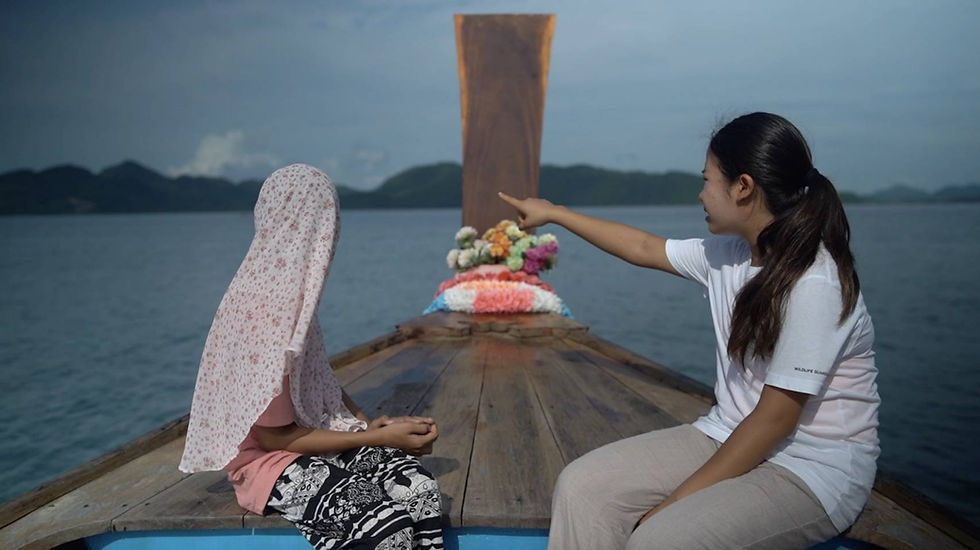
That connection crystallized in 2019 with Mariam, the orphaned baby dugong that captured hearts across Thailand and beyond. For many, Mariam was a fleeting news story. For Claire, it was a turning point.
Seeing the young dugong follow boats, mistaking them for her mother, revealed a painful truth about marine life in human-dominated environments. It was not just about loss, but misunderstanding. The moment stayed with her, eventually taking shape as Mariam: The Lost Dugong, a children’s book she wrote and illustrated to introduce young readers to endangered marine species. Proceeds were directed toward conservation efforts in southern Thailand, but more importantly, the project marked Claire’s shift from observer to storyteller.
From there, her work expanded quickly, but never carelessly. She co-founded the Krabi Sustainable Foundation, focusing on marine conservation and environmental awareness at the community level. Rather than positioning conservation as a distant or scientific concept, the initiative roots it in everyday life, particularly in coastal areas where livelihoods and ecosystems are tightly intertwined.

Still, Claire was asking bigger questions. And to answer them, she turned to film.
At 14, she produced Giants of the Deep: The Whale Shark Story, a documentary exploring the fragile relationship between Thailand’s marine ecosystems and one of its most iconic species. The film’s success across international festivals was notable, but what mattered more was its reach. It brought complex environmental challenges into a format that people could feel, not just understand.
A year later, she followed with Beyond the Surface: The Whale Shark Chronicles, widening the lens to examine how land-based activities ripple into marine environments. Together, the films form a quiet but powerful argument: the ocean’s health is never isolated. It is a reflection of everything happening above it.
Her storytelling has since found its way into classrooms across Thailand through environmental education programs, embedding these ideas early, where they arguably matter most.
But Claire’s current focus is not on the ocean’s most visible creatures. It is on what lies beneath them. In 2024, she launched a seagrass restoration initiative in Krabi, working with government agencies, local communities, and students on Koh Jum Island. Seagrass, often overlooked, plays an outsized role in marine ecosystems. It feeds dugongs and sea turtles, stabilizes coastlines, nurtures fish populations, and absorbs significant amounts of carbon.
It is not glamorous work. It involves diving, planting, and long-term monitoring. But perhaps that is the point. For Claire, conservation is not about spectacle. It is about systems. This systems thinking extends to her upcoming project, BlueQuest, a platform set to launch in 2026 that aims to connect conservation with tourism and local communities. The idea is simple but ambitious: give people the tools to engage with the ocean more responsibly, whether by reporting environmental issues or choosing more sustainable travel experiences.

Her belief is clear. Conservation should not be exclusive. Anyone who loves the ocean should be able to protect it. That philosophy has carried her far beyond Thailand. At 16, Claire became the youngest Thai participant and the only Thai youth representative invited to speak at the United Nations High-Level Political Forum on Sustainable Development in New York, where she addressed the growing threat of rising sea temperatures under SDG 14: Life Below Water.
She has since taken on roles with the Environmental and Social Foundation in Bangkok, contributing to global conversations on environmental responsibility, and was most recently selected for the Youth Leader Davos program in 2026.
Yet, for all the accolades and global platforms, Claire’s language remains grounded. She does not speak in abstractions or grand declarations. She returns, again and again, to something simpler.
The ocean feels like home. And like any home, it is painful to watch it change.
There is a quiet urgency in the way Claire approaches her work. Not alarmist, not performative, but persistent. She understands that awareness alone is not enough. What matters is what people choose to do with it.


Comments